
1″ Silverboard (Plus Other Thicknesses)
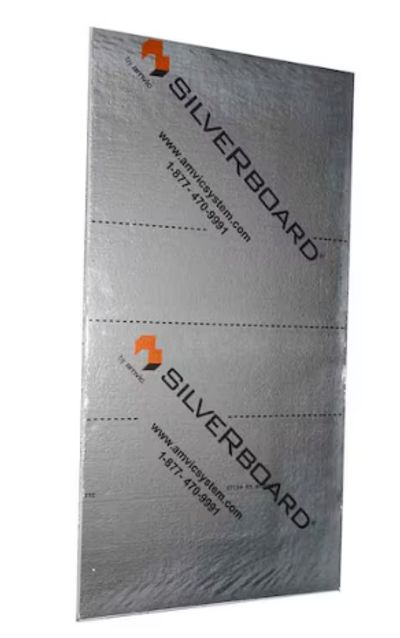
Rigid Board Insulation Installed Behind Siding Systems
Silverboard rigid insulation—most commonly installed in 1″ thickness, with additional thicknesses available—is used behind siding systems to improve exterior wall performance and overall comfort. When installed correctly, rigid board insulation provides continuous thermal resistance and creates a stable backing surface for the siding installed above it.
This page explains what Silverboard is, how it is used behind siding, and when it makes sense to include rigid insulation as part of a complete exterior wall system.
Product Overview

High-Density Rigid Insulation for Exterior Walls
Silverboard is a high-density extruded polystyrene (XPS) rigid insulation board designed for exterior wall applications. Its uniform thickness and compressive strength make it suitable for siding installations where insulation is installed directly behind the cladding.
Unlike flexible insulation products, rigid board insulation maintains its shape over time, resists compression, and provides a consistent surface for fastening siding systems.
Thermal Rating

Understanding What 1″ of Rigid Insulation Provides
1″ Silverboard provides approximately R-5 of continuous exterior insulation. Because it is installed as a continuous layer behind the siding, it helps reduce thermal bridging through wall framing—something interior insulation alone cannot fully address.
While R-value is an important measurement, it represents only one part of wall performance. Real-world comfort and efficiency depend on how well the insulation integrates with wall preparation, fastening methods, and the siding system above it.
Rigid insulation supports more stable interior temperatures and can reduce drafts when combined with proper installation practices.
Silverboard has an approximate R-value of 5 per inch, so nominal values are:
- 1/2" > approx. R 2.5
- 3/4" > approx. R 3.8
- 1" > approx. R 5.0
- 1.5 " > approx. R 7.5
- 2" > approx. R 10
These values represent the insulation material only. Actual energy performance depends on wall construction, fastening methods and overall installation details.
Installation Method
Rigid insulation installed using proven wall assembly methods
Silverboard and similar rigid insulation products can be installed using different wall assembly methods, depending on the home’s construction, existing wall conditions, insulation goals, and siding type.
In many residential retrofit projects, rigid insulation is installed directly over the exterior wall surface, with the siding system fastened through the insulation and anchored into the underlying wall structure. Fastener length and spacing are adjusted to account for insulation thickness, and siding expansion allowances are maintained according to manufacturer requirements.
In other applications, additional components such as housewrap, strapping, or ventilation layers may be incorporated into the wall system. These approaches are typically used when improving moisture management, drainage, or ventilation as part of a larger exterior upgrade.
The appropriate installation method is determined based on:
- Existing wall assembly and sheathing type
- Insulation thickness and energy performance goals
- Siding profile and fastening requirements
- Overall project scope and building conditions
Regardless of the method used, proper wall preparation, fastening, and detailing are essential to long-term performance.
Installation methods are reviewed during the planning stage to ensure compatibility with the siding system and long-term durability.
Thickness Options
Why 1″ Is Common — and When Thicker Boards Are Used
1″ Silverboard is the most commonly used thickness behind siding because it balances improved thermal performance with compatibility across most siding systems. Thicker rigid insulation boards are available and may be specified when additional thermal resistance is desired.
Thickness selection depends on:
- performance goals
- existing wall construction
- siding profile and fastening requirements
- overall project scope
Choosing the correct thickness ensures the siding fits properly and continues to perform as designed.
Fastening Considerations

Maintaining Secure Attachment Through Insulation
When siding is installed over rigid insulation, fasteners must be long enough to securely anchor into the wall structure while still allowing normal siding movement. Improper fastener selection or over-tightening can compress insulation or restrict expansion.
This is why rigid insulation should always be planned as part of the siding system—not added without adjusting installation methods.
Use Cases

Projects That Benefit Most From Rigid Insulation
Silverboard rigid insulation is commonly used when:
- energy performance improvements are a priority
- full or partial siding replacement is planned
- older homes have minimal exterior insulation
- insulated siding systems are being considered
- homeowners want improved comfort without interior renovations
It can be installed on full homes, additions, dormers, and bay build-outs where performance upgrades are desired.